
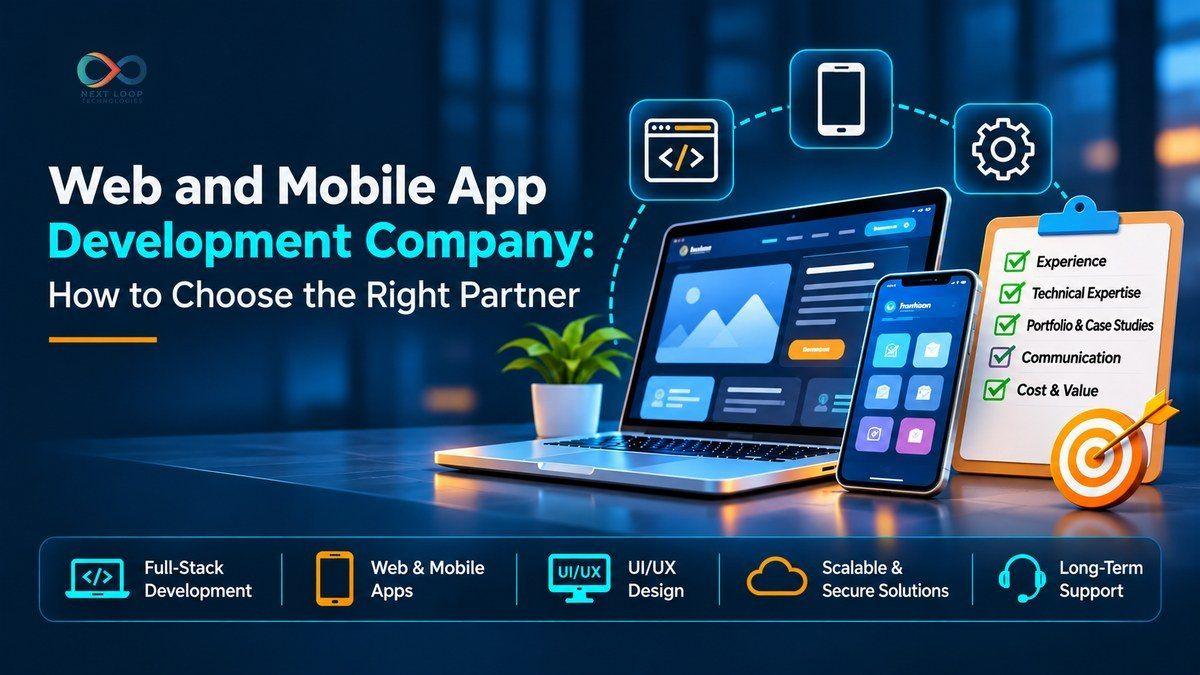
Web and Mobile App Development Company: How to Choose the Right Partner
The Author
Aditi Agrawal is an SEO Executive at Nextloop Technologies who writes about SEO, digital marketing, technology, and emerging trends in the digital landscape. Her work focuses on sharing practical, easy-to-understand insights to help businesses strengthen their online presence and visibility.
Choosing the right partner means judging technical capability, delivery evidence, project transparency, and long-term product ownership, not the polish of a pitch. A competent web and mobile app development company can explain how every screen, API, and database will work together and who maintains them once the product is live.
The danger is a proposal that looks affordable because it quietly leaves out backend work, integrations, testing, or maintenance. These gaps often appear during the project, typically resulting in costly change requests. This guide treats web and mobile as a single connected product and shows exactly what to verify before you sign a contract.
Key Takeaways
- Judge how web, mobile, and backend fit together, not the screens alone.
- Choose native, cross-platform, or web from your requirements; none is universally better.
- Compare proposals by assumptions and exclusions, not totals.
- Ownership means repositories, cloud accounts, credentials, and documentation, not code alone.
What Should You Look for in a Web and Mobile App Development Company?
A brief that says "we need a website and an app" is not a proper brief. A real product has customer-facing interfaces, an admin dashboard, shared backend services, authentication, business rules, and third-party integrations. Take a booking feature: it must handle unavailable slots, duplicate submissions, payment failures, and confirmation errors. Those are acceptance criteria, and a capable partner asks for them during discovery.
Good full-stack app development shows in how responsibilities are divided: who designs the APIs, owns the database, handles deployment, and watches production. Clarity matters more than headcount; a small team with clear ownership can outperform a large one with gaps.
That is why web and mobile software development works best as one effort: when both clients share a backend, business rules live in one place instead of drifting apart.
Which Technical Approach Fits Your Product?
Native apps are developed separately for iOS and Android, and that makes sense if your product depends on platform-specific features or needs deep access to the device. The downside is that you have two codebases to build and maintain.
React Native and Flutter allow substantial code reuse across both platforms, but reuse is not an exemption. Native integrations, accessibility, operating-system differences, and platform-specific testing remain, as Flutter's documentation on platform integration indicates. Ask any team offering cross-platform app development where it expects native work in your product.
Responsive web applications and progressive web apps suit browser-based workflows such as administration, reporting, and transactions. Often the sensible answer is a mix: a web admin portal, a cross-platform customer app, and shared backend services.
What Should You Check Before Hiring a Development Partner?
Read the portfolio as evidence, not decoration. A screenshot proves a design exists, not that the team built the system behind it. Ask which parts the company actually delivered, whether the product is live, and which decision was hardest.
Relevance matters too. A web application development company that has shipped dashboards may never have handled offline mobile sync.
- QA: a mobile app can pass every screen check in isolation yet fail when the backend returns an error or connectivity drops, so testing should cover those conditions, plus permissions, regression, and a defined device list, with release criteria agreed upfront.
- Security: ask about authentication, authorisation, dependency updates, and vulnerability management. OWASP MASVS and NIST's SSDF are useful benchmarks, though no framework guarantees security.
- Architecture: ask how the design copes with your expected workloads, the systems it must connect to, and the changes you are likely to make later. Be wary of anyone who promises unlimited scalability.
- Ownership: you can hold the full source code and still be stuck if the cloud access, environment settings, or deployment instructions are with the vendor. Get repository access, IP terms, cloud accounts, credentials, backups, and documentation in writing.
- Post-launch support: The agreement should include bug fixes, security patches, OS updates, monitoring, and recovery in case of some breakage. Verify the package contents and any separately charged items.
How Can You Compare Proposals Without Choosing on Price Alone?
Two quotes are comparable only when scope, assumptions, exclusions, and responsibilities match. An apparently cheap one may leave out data migration, third-party integrations or app-store preparation. Ask every vendor to itemise discovery, backend, integrations, testing, infrastructure, deployment and maintenance; anything marked "to be discussed" is a cost you have not seen yet.
Fixed-price suits a well-defined scope but resists change; time-and-materials flexes with learning but needs visible progress. Neither is always better. Apple's App Review Guidelines can also add review cycles to a release.
A longer discovery phase is not a cause for concern. Unusual business logic means custom software development services need more upfront analysis, and that analysis makes the estimate honest.
Score each shortlisted vendor from 1 to 5 on six criteria. This is an illustrative framework, not an industry benchmark.
|
Criterion |
Score 1 (weak) |
Score 5 (strong) |
|
Architecture and integration planning |
Generic stack, integrations "later" |
Design tied to workloads, integrations and failure handling |
|
Verifiable portfolio evidence |
Screenshots only |
Named contribution, live product, reference call |
|
Discovery and estimate transparency |
One lump sum |
Itemised, with assumptions and exclusions |
|
QA, security and release process |
"We test everything." |
Defined test scope, release criteria, vulnerability handling |
|
Ownership and handover |
Vague terms |
Accounts, repositories, credentials and documentation transferred |
|
Post-launch support |
Undefined or unpriced |
Scope, response times and costs stated |
Weight criteria to suit your product, but treat a 1 or 2 on architecture, testing, ownership or support as a blocker. A low price should not outweigh those weaknesses.
What Questions and Warning Signs Matter Most?
Put these to every shortlisted vendor:
- Which parts of your portfolio did your own team build?
- What is excluded from this estimate?
- Which accounts and credentials will be in my name from day one?
Be cautious of a fixed delivery date promised before discovery, vague ownership terms, or claims of bug-free software and guaranteed success. A mobile app development company that cannot name its technical lead deserves the same scrutiny.
How Do You Know You've Found the Right Partner?
The right partner challenges vague requirements, shows work you can verify, explains trade-offs without selling one framework, prices honestly, and puts ownership in writing. A short paid discovery phase is a low-risk way to test how any web mobile app development company works.
If you want to see how a team approaches the project, explore the web and mobile development services from Nextloop Technologies and review its portfolio first.
FAQs
How much does web and mobile application development cost?
Cost depends on scope, platforms, backend complexity, integrations, design depth, and the testing and support required. Ask for an itemised estimate with stated assumptions, not just a single figure.
Should a business choose native or cross-platform apps?
It depends on the product's needs. Native suits heavy use of device capabilities or platform-specific behaviour; cross-platform suits shared features launched on both platforms from a single codebase. Either way, plan for platform-specific testing.
Who should own the source code after development?
In most cases, the client owns the source code, provided the contract states the terms in writing, and the payments are settled. Look for carve-outs covering the vendor’s reusable components and any open-source licences. Also, make sure the repositories come with build and deployment access, as code that cannot be deployed is of little use.
What should a development and maintenance agreement include?
Start with scope, deliverables, and payment milestones. Then cover who owns the IP, what handover materials you will receive, and how long defects are fixed under warranty. For post-launch support, get response times in writing. Also state which third-party licences and cloud accounts are held in your name.
How long does web and mobile app development take?
No single timeline fits every project. It depends on scope, platform choices, integrations, how much discovery is needed, testing, outside dependencies, and how quickly approvals come through. Rather than accepting one delivery date, ask vendors for a phased plan that lists its assumptions.
What happens if the project scope changes during development?
A documented change request should state the effect on cost and schedule, be prioritised against existing work, and be approved in writing before development begins. That is a managed process, not an inflexible contract.
Featured Blogs
How to Choose a Mobile App Development Company?
To choose the right mobile app development company, check three things first: proof of real work, skill on the platforms you need, and a clear plan for testing, launch, and support. A good partner explains every step in plain words and agrees on a clear scope before any code is written.That sounds simple, but many businesses still pick a team based on price alone. Months later, they end up with a slow app, missed deadlines, and a product nobody wants to update. This guide walks you through each point to check so you can avoid that.What Should You Decide Before You Start Looking?Before you talk to any mobile app development company, get clear on what you want your app to do. Teams can only give you an honest quote and timeline when they know your goals.Answer these four questions first:Who is the app for? Describe your users and the problem the app solves for them.What must version one include? List only the features you can't launch without.What are your limits? Note your budget range and target launch date.What does it connect to? Think about payment gateways, a CRM, or other tools.If your idea is still new, you don't need to build everything at once. Many startups begin with MVP development services to test the core idea with real users. This keeps early costs low and shows you what to build next.How Can You Check a Team's Real Experience?A polished sales pitch tells you very little. What matters is the work a team has already shipped and how its clients feel about it.When you review a mobile application development company, use this simple checklist: What to Ask For Why It Matters Live apps you can download Shows real quality, not just mockups Detailed case studies Proves they can solve problems and deliver results Client reviews on trusted platforms Reveals how they communicate and meet deadlines Industry experience Means less learning time on your project Names of the actual team members Confirms who will write your code Pay close attention to that last point. The people on your sales calls should be the same people working on your project, or at least closely involved.Do You Need an Android App, an iOS App, or Both?Let your users decide. Check which phones your audience uses, then choose your platform.When Android Comes FirstPick an Android app development company that can make your app run smoothly on many screen sizes, from budget phones to flagships.When iOS Comes FirstChoose an iOS app development company that knows Apple's design rules and App Store review process, so your launch isn't delayed.When You Need BothIf your audience is split, plan for both platforms from day one. That leads to the next decision: how to build the app.Should You Go Native or Cross-Platform?Both options work well. The right one depends on your budget, timeline, and the kind of app you want. Factor Native Cross-Platform How it's built Separate code for Android (Kotlin/Java) and iOS (Swift) One codebase using React Native or Flutter Speed to launch Slower Faster Cost Higher Lower Performance Best possible Near-native for most apps Best for Games, heavy graphics, deep hardware use Business apps, startups, dual-store launches A good partner won't push one option on everyone. With custom mobile app development, the tech choice should match your goals, your users, and your budget.Why Does UI/UX Design Make or Break an App?Users decide within seconds if an app is worth keeping. If screens feel confusing or slow, they delete it and move on.So ask to see a team's wireframes and design process, not just final screens. A strong mobile app development company will study your users, map their journey, and test designs before coding starts.Good design looks like this:Key features reachable in just a few tapsClear buttons and easy-to-read textFast load times on every screenA consistent look that matches your brandTip: If you are launching with MVP development services, keep the design clean and focused. A simple first version that works well beats a crowded one that confuses people.How Does the Team Handle Security and Testing?Your app may store personal details, payment data, or health records. One gap in either security or testing can damage user trust for good.Security Questions to AskThat's why you should ask exactly how a team protects data. Solid mobile app development services should cover:Encryption: Data is protected both when stored and when sentSecure login: Options like two-factor authenticationSafe connections: Secure APIs and regular code reviewsCompliance: Rules that apply to your industry are followedTesting Questions to AskDevices: How many real phones do they test on, not just simulators?Performance: Do they check speed and load under heavy traffic?Bugs: How do they track, fix, and retest issues before release?What Happens at Launch and After the App Goes Live?Launching an app means more than uploading a file. Here's what a reliable partner should handle, step by step:Step 1Store PreparationThey create store listings, screenshots, and descriptions for Google Play and the App Store.Step 2Submission and ApprovalThey manage the review process and fix anything that could lead to a rejection.Step 3App Store OptimizationThey improve keywords and visuals so people can actually find your app.Step 4Ongoing MaintenanceThey fix bugs, support new Android and iOS versions, and add features based on user feedback.Step 5Web SupportMany apps also need an admin panel or customer portal. If that's part of your plan, check whether your partner can also act as a web application development company, so both sides of your product connect smoothly.Can Your Partner Grow With Your Business?Your needs will change after launch. A good partner should offer more than one way to support you.🔹 Need more hands? Some businesses add skilled people to their in-house team through IT staff augmentation services. This gives you expert developers quickly, without long hiring cycles.🔹 Need more than an app? A partner that also offers custom software development services can build internal tools, dashboards, and AI features that work with your app. One team means fewer handoffs and better results.Start Your App Project With Nextloop TechnologiesThe right partner sets clear goals with you, shows real work, and covers design, security, testing, and support. Our team follows a simple Discover, Design, Build, and Deliver process to launch apps on both Android and iOS.If you want a mobile app development company that stays with you after launch, Nextloop Technologies is ready to help.Ready to build your app? Talk to Nextloop Technologies today and get a free project consultation.Key Takeaways:Set your goals, budget, and must-have features before contacting any teamCheck portfolios, client reviews, and the tools a team actually usesDecide early if you need Android, iOS, or bothPick native or cross-platform based on speed, budget, and performanceAsk how the team handles design, security, testing, and app store releaseMake sure support and updates continue after launchFAQs:Q1. How long does it take to build a mobile app? A simple app can take 2 to 4 months, while a complex one may take 6 months or more. The timeline depends on features, platforms, design, and testing needs.Q2. How much does it cost to develop a mobile app? Cost depends on features, the number of platforms, design work, and integrations. A clear scope at the start helps you get an accurate quote and avoid surprise costs.Q3. Is a cross-platform app as good as a native app? For most business apps, yes. React Native and Flutter offer near-native speed. Native is still the better choice for apps with heavy graphics or deep hardware use.Q4. Who owns the source code after the app is built? You should. Make sure your contract clearly states that you own the source code and all intellectual property once the project is paid for.Q5. Do I need ongoing maintenance after launch? Yes. Regular updates keep your app secure, fix bugs, and make sure it keeps working with new Android and iOS versions.
Read More →
How to Choose a Web Application Development Company?
To choose the right web application development company, check five things: the tech stack they use, how they protect your data, whether the app can grow with you, how well it connects with your tools, and what support you get after launch. A partner who is strong in all five will save you time, money, and stress.A web app is often at the center of how a business runs. It may handle orders, bookings, customer data, or your team's daily work. So picking the wrong partner can hurt more than just your budget.This guide walks you through each factor in plain words so that you can compare your options with confidence.Why Does Your Choice of Development Partner Matter So Much?A good web application development company does more than write code. It helps you plan the right features, avoid costly mistakes, and launch a product people actually enjoy using.A weak partner can leave you with slow pages, security gaps, and messy code that no one else can fix. Fixing these problems later often costs more than building it right the first time.It also helps to pick a team that offers wider custom software development services. As your business changes, you won't need to hunt for a new vendor every time a new need comes up.What Technology Stack Should Your Web App Partner Use?The tech stack is the set of tools used to build your app. It affects speed, cost, and how easy the app is to update later.Ask the company:Which frontend tools do they use, such as React, Angular, or Vue.js?Which backend languages and databases do they work with?Do they use cloud platforms for hosting and deployment?Can they explain why a certain tool is right for your project?A good partner picks tools based on your needs, not their habits. At Nextloop Technologies, our teams work with modern frameworks like React, Angular, Vue.js, and Svelte. We choose the stack only after we understand your goals.How Can You Tell If a Company Takes Security Seriously?Your web app will likely store customer details, logins, or payment data. One breach can break trust that took years to build.Look for these signs:Data encryption for stored and shared informationSecure logins and user access controlsRegular security checks and code reviewsTesting for weak spots before launchKnowledge of rules like PCI compliance for paymentsThis matters even more for large companies. In enterprise web application development, one app may serve thousands of users across many teams, so security must be planned from day one.Will the App Be Able to Grow With Your Business?Your app may start with 100 users and reach 100,000 a year later. If it isn't built for growth, it will slow down or crash right when you need it most.Ask how the team handles scalable web application development. Good answers include cloud hosting, clean code structure, and load testing before launch.If you want to test an idea first, MVP development services let you launch a simple version, learn from real users, and then grow with less risk.Sometimes growth means going beyond one web app. A partner that offers custom software development services can also build internal tools, dashboards, or automation as your needs expand.Can the Web App Connect With Your Existing Tools?Most businesses already use tools like a CRM, payment gateway, ERP, or email platform. Your new app should work smoothly with all of them.Ask about:Their experience with APIs and third-party integrationsPast projects that connected similar systemsHow they keep data in sync between toolsA skilled web application development company will map these connections early, during planning. This avoids nasty surprises halfway through the build.Also think ahead about mobile. If you may need a phone app later, a partner that also works as a mobile app development company can keep your web and mobile products in sync.What Does a Clear Development Process Look Like?A clear process keeps your project on time and on budget. You should always know what is being built and what comes next.At Nextloop, we follow four simple steps:Discover: We learn about your business, users, and goals.Design: We create wireframes, easy-to-use screens, and the system plan.Build: Our engineers work in short agile sprints, so you see progress often.Deliver: We test the app fully, launch it, and keep watching its health.This kind of structure is key in custom web application development, where every feature is made for your exact workflow.Ask any partner to walk you through their steps. If they can't explain it simply, treat that as a red flag.Who Will Maintain and Support the App After Launch?Launch day is not the finish line. Apps need bug fixes, updates, speed checks, and new features over time.Before you sign, ask:Do they offer ongoing maintenance plans?How fast do they respond when something breaks?Will the team that built the app also support it?The best web application development services include support after launch, not just the build. This keeps your app safe, fast, and up to date.How Do You Compare Cost, Team, and Track Record?Price matters, but the cheapest quote often costs more later. Compare the value, not only the number.Check:Portfolio and case studies in your industryClient reviews and ratingsTeam size and skill mixClear pricing and flexible hiring modelsSome businesses already have an in-house team but need extra hands. In that case, IT staff augmentation services let you add skilled developers without long hiring cycles.As a web app development company with 8+ years of experience, 80+ tech professionals, 40+ successful projects, and 98%+ client satisfaction, Nextloop Technologies supports startups, healthcare providers, and global enterprises. We serve fields like fintech, healthcare, oil and gas, and food and beverages.Start Your Search With a Simple ShortlistFirst, write down your must-have features, budget, and timeline. Then shortlist three companies and ask each one about tech, security, growth, integrations, process, and support.Compare their answers side by side. The right partner will answer clearly, ask smart questions back, and care about your goals.If you want a partner that checks all these boxes, Nextloop Technologies is ready to help. Talk to our team today and see why businesses trust us as their web application development company.Key Takeaways:Pick a partner whose tech stack fits your goals, not just the latest trend.Ask how they secure your data, from encryption to testing.Make sure the app is built to handle more users over time.Check that they can connect the app with the tools you already use.Look for a clear process and real support after launch.FAQs:1. How long does it take to build a web app? A simple web app may take 2 to 4 months. A complex one with many features and integrations can take 6 months or more. Testing and feedback rounds also affect the timeline.2. How much does it cost to build a web app? The cost depends on features, design, integrations, and team size. The best way to know is to share your needs and ask for a detailed, itemized quote.3. What is the difference between a website and a web app? A website mostly shares information. A web app lets users do things, like log in, book a slot, place an order, or manage data.4. Should I launch a small version of my app first? Yes, if your idea is new. Launching a basic version first helps you test demand, collect real feedback, and spend your budget more wisely.5. Can I add new features after my web app goes live? Yes. If the app is built with clean code and a flexible structure, your team can add features, improve speed, and update design over time.
Read More →
Future of Web Development: Key Trends Shaping Modern Websites
IntroductionThe web development landscape continues to evolve as new technologies change how websites and web applications are designed, built, and maintained. From artificial intelligence and faster browser experiences to accessible design and sustainable coding practices, these developments are creating new opportunities for businesses.Understanding these trends can help businesses make informed technology decisions, improve user experiences, and build digital products that remain useful as customer expectations change.1. Artificial Intelligence in Web DevelopmentArtificial intelligence is changing how developers build, test, and improve websites. AI-powered tools can assist with coding, identify potential bugs, and help businesses deliver more personalized digital experiences.Key applications include:AI coding assistants: Help developers write, explain, and review code.Automated testing: Identify potential issues and streamline software testing.Personalized experiences: Adapt website content and recommendations to relevant user preferences.Intelligent chatbots: Help visitors find information and answer common questions.Although AI can improve development workflows, human review remains essential for code quality, security, and accessibility.2. WebAssembly: Making Browsers More PowerfulWebAssembly (Wasm) is a technology that allows compatible code to run in web browsers efficiently. It can support demanding applications that involve graphics, simulations, image processing, and complex calculations.Key advantages include:High-performance applications: Run computationally intensive tasks in the browser.Advanced browser experiences: Support graphics-intensive tools, games, and interactive applications.Broader development options: Allow developers to use languages beyond JavaScript for suitable browser-based tasks.Actual performance depends on the application, browser, and implementation.3. Jamstack: Building Faster and More Scalable WebsitesJamstack is a web architecture that commonly uses pre-rendered pages, APIs, and reusable services to deliver website content efficiently. By serving pre-built pages through content delivery networks, developers can improve performance and manage traffic more effectively.Key benefits include:Faster loading: Pre-rendered content can reduce the work required to serve each page.Improved security options: Separating the front end from certain backend systems can reduce the exposed attack surface.Scalability: Content delivery networks can help websites handle increases in visitor traffic.Flexible architecture: APIs allow developers to connect external services as needed.The best architecture depends on the website's content, functionality, and maintenance requirements.4. Progressive Web Apps (PWAs)Progressive Web Apps (PWAs) use web technologies to provide app-like experiences through a browser. Depending on browser and device support, they can offer installation, offline functionality, and push notifications.Important PWA capabilities include:Installability: Users may add the application to their device's home screen.Offline support: Cached content and service workers can support selected features without an internet connection.Engagement features: Supported devices and browsers can receive web push notifications.Responsive experiences: PWAs can adapt to different screen sizes and devices.PWAs can be useful for businesses that want to improve mobile web experiences without maintaining separate native applications for every platform.5. Low-Code DevelopmentLow-code development uses visual interfaces, reusable components, and pre-built functionality to reduce the amount of code needed to build applications.It can help businesses and development teams:Build prototypes faster: Test concepts before committing to larger projects.Reduce repetitive development work: Reuse components for common features.Support collaboration: Allow technical and non-technical teams to contribute to suitable projects.Accelerate delivery: Create internal tools and business applications more efficiently.Low-code platforms still require careful consideration of customization, security, scalability, and vendor dependency.6. API-First DevelopmentAPI-first development prioritizes designing application programming interfaces (APIs) before building the systems that use them. APIs allow different applications and services to exchange information.This approach can provide several advantages:Better integration: Connect websites with payment systems, CRMs, and other services.Multi-platform delivery: Share data and functionality across websites, mobile apps, and other channels.Independent development: Enable different components to evolve with fewer dependencies.Easier maintenance: Well-designed APIs create clear contracts between systems.Strong API documentation, authentication, and version management are important for reliable implementation.7. Web Accessibility and Inclusive DesignWeb accessibility helps ensure that websites and applications can be used by people with different abilities, including those who rely on assistive technologies.Important practices include:Keyboard navigation: Ensure interactive elements can be accessed without a mouse.Screen reader compatibility: Use semantic HTML and meaningful labels.Readable design: Maintain suitable contrast, typography, and clear page structure.Accessible media: Provide alternative text and captions where appropriate.Inclusive testing: Evaluate websites with accessibility tools and real user needs in mind.Accessibility improves usability and can help businesses meet applicable accessibility requirements.8. Sustainable Web DevelopmentSustainable web development focuses on reducing unnecessary resource consumption while maintaining useful, reliable digital experiences.Businesses and developers can support more sustainable websites through:Efficient code: Reduce unnecessary processing and scripts.Optimized media: Compress images and serve appropriately sized assets.Performance improvements: Limit unnecessary network requests and page weight.Efficient infrastructure: Choose hosting and delivery options that suit performance and resource requirements.Long-term maintainability: Build software that can be updated instead of repeatedly replaced.These practices can improve performance while helping reduce the resources required to deliver digital services.9. How Modern Web Development Services Help Businesses Adopt These TrendsAdopting new web technologies requires more than following industry trends. Businesses need to select solutions that fit their objectives, users, existing systems, security requirements, and long-term plans.Professional web development can help organizations build responsive websites, create interactive web applications, integrate APIs, improve website performance, and deliver consistent experiences across devices.At Nextloop Technologies, businesses can explore web development services to learn more about developing digital solutions aligned with their business requirements.Whether a business is planning a new website, modernizing an existing platform, or building a feature-rich web application, a well-planned development process can help balance functionality, performance, accessibility, security, and maintainability.The right technology choices should be driven by user needs and business goals rather than adopting every emerging trend.10. How Nextloop Technologies Approaches Modern Web DevelopmentAt Nextloop Technologies, modern web development principles can help businesses create digital experiences that support usability, performance, and growth.Important considerations when planning a web project include:Performance: Optimize page speed, images, scripts, and other resources.Responsive design: Ensure the website works across desktop, tablet, and mobile devices.Accessibility: Make content and interactions usable by a broader audience.Maintainability: Use suitable architecture and development practices for long-term improvements.Integration: Connect the website with relevant business tools and services.Security: Apply appropriate safeguards throughout development and maintenance.Selecting the right combination of technologies depends on the project's goals, budget, complexity, and expected growth.Conclusion: Preparing for the Future of Web DevelopmentThe future of web development will be shaped by advances in AI, browser performance, modern architecture, app-like web experiences, API integration, accessibility, and sustainability.Businesses do not need to adopt every new technology to remain competitive. Instead, they should prioritize improvements that solve real user problems, support business objectives, and provide long-term value.With thoughtful planning and the right technical approach, organizations can build websites and web applications that are useful, secure, accessible, and ready to evolve with changing needs.Ready to plan your next digital project? Contact Nextloop Technologies to discuss your website and web application development goals.
Read More →