
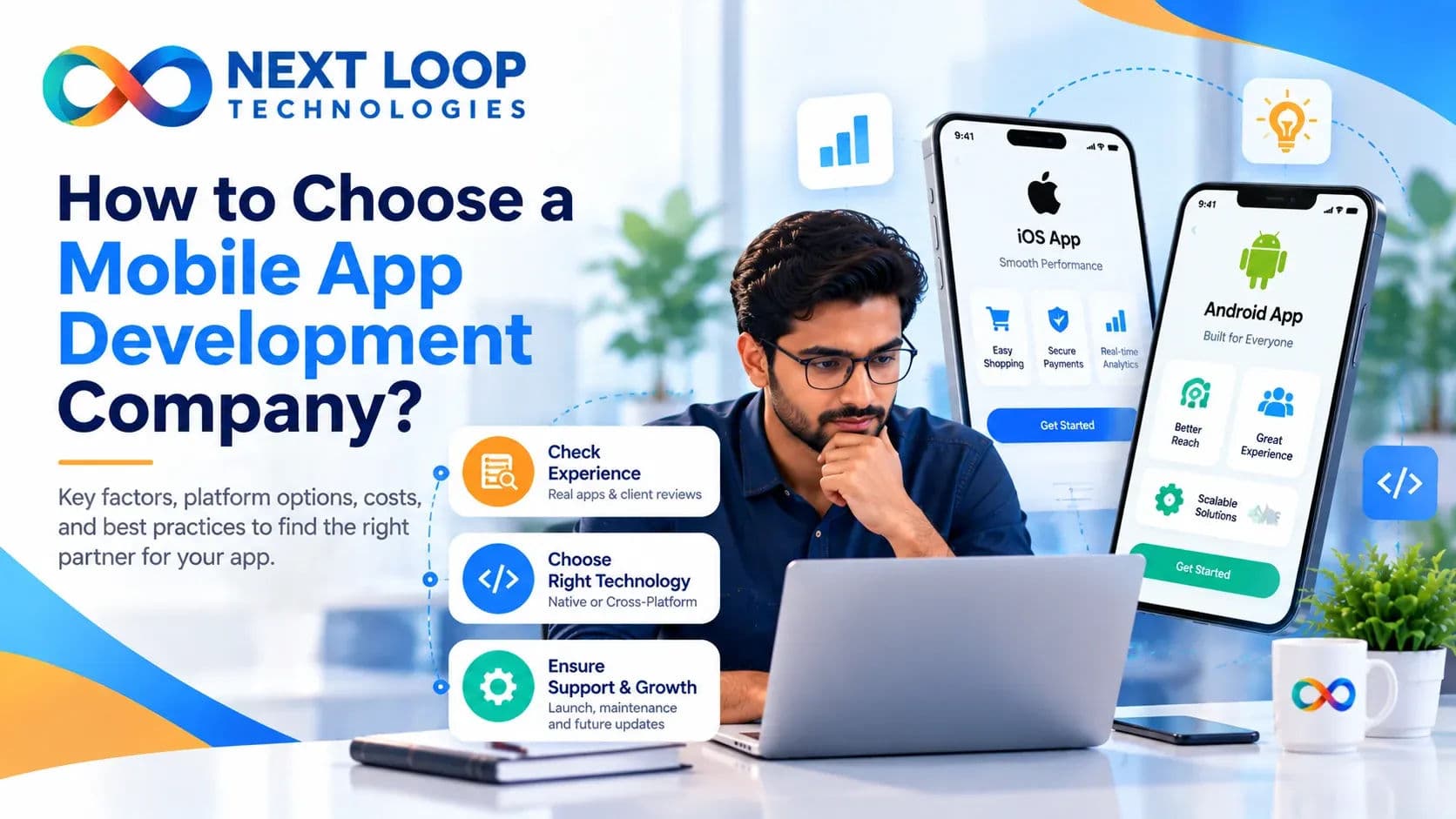
How to Choose a Mobile App Development Company?
The Author
Aditi Agrawal is an SEO Executive at Nextloop Technologies who writes about SEO, digital marketing, technology, and emerging trends in the digital landscape. Her work focuses on sharing practical, easy-to-understand insights to help businesses strengthen their online presence and visibility.
To choose the right mobile app development company, check three things first: proof of real work, skill on the platforms you need, and a clear plan for testing, launch, and support. A good partner explains every step in plain words and agrees on a clear scope before any code is written.
That sounds simple, but many businesses still pick a team based on price alone. Months later, they end up with a slow app, missed deadlines, and a product nobody wants to update. This guide walks you through each point to check so you can avoid that.
What Should You Decide Before You Start Looking?
Before you talk to any mobile app development company, get clear on what you want your app to do. Teams can only give you an honest quote and timeline when they know your goals.
Answer these four questions first:
- Who is the app for? Describe your users and the problem the app solves for them.
- What must version one include? List only the features you can't launch without.
- What are your limits? Note your budget range and target launch date.
- What does it connect to? Think about payment gateways, a CRM, or other tools.
If your idea is still new, you don't need to build everything at once. Many startups begin with MVP development services to test the core idea with real users. This keeps early costs low and shows you what to build next.
How Can You Check a Team's Real Experience?
A polished sales pitch tells you very little. What matters is the work a team has already shipped and how its clients feel about it.
When you review a mobile application development company, use this simple checklist:
|
What to Ask For |
Why It Matters |
|
Live apps you can download |
Shows real quality, not just mockups |
|
Detailed case studies |
Proves they can solve problems and deliver results |
|
Client reviews on trusted platforms |
Reveals how they communicate and meet deadlines |
|
Industry experience |
Means less learning time on your project |
|
Names of the actual team members |
Confirms who will write your code |
Pay close attention to that last point. The people on your sales calls should be the same people working on your project, or at least closely involved.
Do You Need an Android App, an iOS App, or Both?
Let your users decide. Check which phones your audience uses, then choose your platform.
When Android Comes First
Pick an Android app development company that can make your app run smoothly on many screen sizes, from budget phones to flagships.
When iOS Comes First
Choose an iOS app development company that knows Apple's design rules and App Store review process, so your launch isn't delayed.
When You Need Both
If your audience is split, plan for both platforms from day one. That leads to the next decision: how to build the app.
Should You Go Native or Cross-Platform?
Both options work well. The right one depends on your budget, timeline, and the kind of app you want.
|
Factor |
Native |
Cross-Platform |
|
How it's built |
Separate code for Android (Kotlin/Java) and iOS (Swift) |
One codebase using React Native or Flutter |
|
Speed to launch |
Slower |
Faster |
|
Cost |
Higher |
Lower |
|
Performance |
Best possible |
Near-native for most apps |
|
Best for |
Games, heavy graphics, deep hardware use |
Business apps, startups, dual-store launches |
A good partner won't push one option on everyone. With custom mobile app development, the tech choice should match your goals, your users, and your budget.
Why Does UI/UX Design Make or Break an App?
Users decide within seconds if an app is worth keeping. If screens feel confusing or slow, they delete it and move on.
So ask to see a team's wireframes and design process, not just final screens. A strong mobile app development company will study your users, map their journey, and test designs before coding starts.
Good design looks like this:
- Key features reachable in just a few taps
- Clear buttons and easy-to-read text
- Fast load times on every screen
- A consistent look that matches your brand
Tip: If you are launching with MVP development services, keep the design clean and focused. A simple first version that works well beats a crowded one that confuses people.
How Does the Team Handle Security and Testing?
Your app may store personal details, payment data, or health records. One gap in either security or testing can damage user trust for good.
Security Questions to Ask
That's why you should ask exactly how a team protects data. Solid mobile app development services should cover:
- Encryption: Data is protected both when stored and when sent
- Secure login: Options like two-factor authentication
- Safe connections: Secure APIs and regular code reviews
- Compliance: Rules that apply to your industry are followed
Testing Questions to Ask
- Devices: How many real phones do they test on, not just simulators?
- Performance: Do they check speed and load under heavy traffic?
- Bugs: How do they track, fix, and retest issues before release?
What Happens at Launch and After the App Goes Live?
Launching an app means more than uploading a file. Here's what a reliable partner should handle, step by step:
Step 1
Store Preparation
They create store listings, screenshots, and descriptions for Google Play and the App Store.
Step 2
Submission and Approval
They manage the review process and fix anything that could lead to a rejection.
Step 3
App Store Optimization
They improve keywords and visuals so people can actually find your app.
Step 4
Ongoing Maintenance
They fix bugs, support new Android and iOS versions, and add features based on user feedback.
Step 5
Web Support
Many apps also need an admin panel or customer portal. If that's part of your plan, check whether your partner can also act as a web application development company, so both sides of your product connect smoothly.
Can Your Partner Grow With Your Business?
Your needs will change after launch. A good partner should offer more than one way to support you.
🔹 Need more hands?
Some businesses add skilled people to their in-house team through IT staff augmentation services. This gives you expert developers quickly, without long hiring cycles.
🔹 Need more than an app?
A partner that also offers custom software development services can build internal tools, dashboards, and AI features that work with your app. One team means fewer handoffs and better results.
Start Your App Project With Nextloop Technologies
The right partner sets clear goals with you, shows real work, and covers design, security, testing, and support. Our team follows a simple Discover, Design, Build, and Deliver process to launch apps on both Android and iOS.
If you want a mobile app development company that stays with you after launch, Nextloop Technologies is ready to help.
Ready to build your app? Talk to Nextloop Technologies today and get a free project consultation.
Key Takeaways:
- Set your goals, budget, and must-have features before contacting any team
- Check portfolios, client reviews, and the tools a team actually uses
- Decide early if you need Android, iOS, or both
- Pick native or cross-platform based on speed, budget, and performance
- Ask how the team handles design, security, testing, and app store release
- Make sure support and updates continue after launch
FAQs:
Q1. How long does it take to build a mobile app?
A simple app can take 2 to 4 months, while a complex one may take 6 months or more. The timeline depends on features, platforms, design, and testing needs.
Q2. How much does it cost to develop a mobile app?
Cost depends on features, the number of platforms, design work, and integrations. A clear scope at the start helps you get an accurate quote and avoid surprise costs.
Q3. Is a cross-platform app as good as a native app?
For most business apps, yes. React Native and Flutter offer near-native speed. Native is still the better choice for apps with heavy graphics or deep hardware use.
Q4. Who owns the source code after the app is built?
You should. Make sure your contract clearly states that you own the source code and all intellectual property once the project is paid for.
Q5. Do I need ongoing maintenance after launch?
Yes. Regular updates keep your app secure, fix bugs, and make sure it keeps working with new Android and iOS versions.