

How to Choose a Web Application Development Company?
The Author
Aditi Agrawal is an SEO Executive at Nextloop Technologies who writes about SEO, digital marketing, technology, and emerging trends in the digital landscape. Her work focuses on sharing practical, easy-to-understand insights to help businesses strengthen their online presence and visibility.
To choose the right web application development company, check five things: the tech stack they use, how they protect your data, whether the app can grow with you, how well it connects with your tools, and what support you get after launch. A partner who is strong in all five will save you time, money, and stress.
A web app is often at the center of how a business runs. It may handle orders, bookings, customer data, or your team's daily work. So picking the wrong partner can hurt more than just your budget.
This guide walks you through each factor in plain words so that you can compare your options with confidence.
Why Does Your Choice of Development Partner Matter So Much?
A good web application development company does more than write code. It helps you plan the right features, avoid costly mistakes, and launch a product people actually enjoy using.
A weak partner can leave you with slow pages, security gaps, and messy code that no one else can fix. Fixing these problems later often costs more than building it right the first time.
It also helps to pick a team that offers wider custom software development services. As your business changes, you won't need to hunt for a new vendor every time a new need comes up.
What Technology Stack Should Your Web App Partner Use?
The tech stack is the set of tools used to build your app. It affects speed, cost, and how easy the app is to update later.
Ask the company:
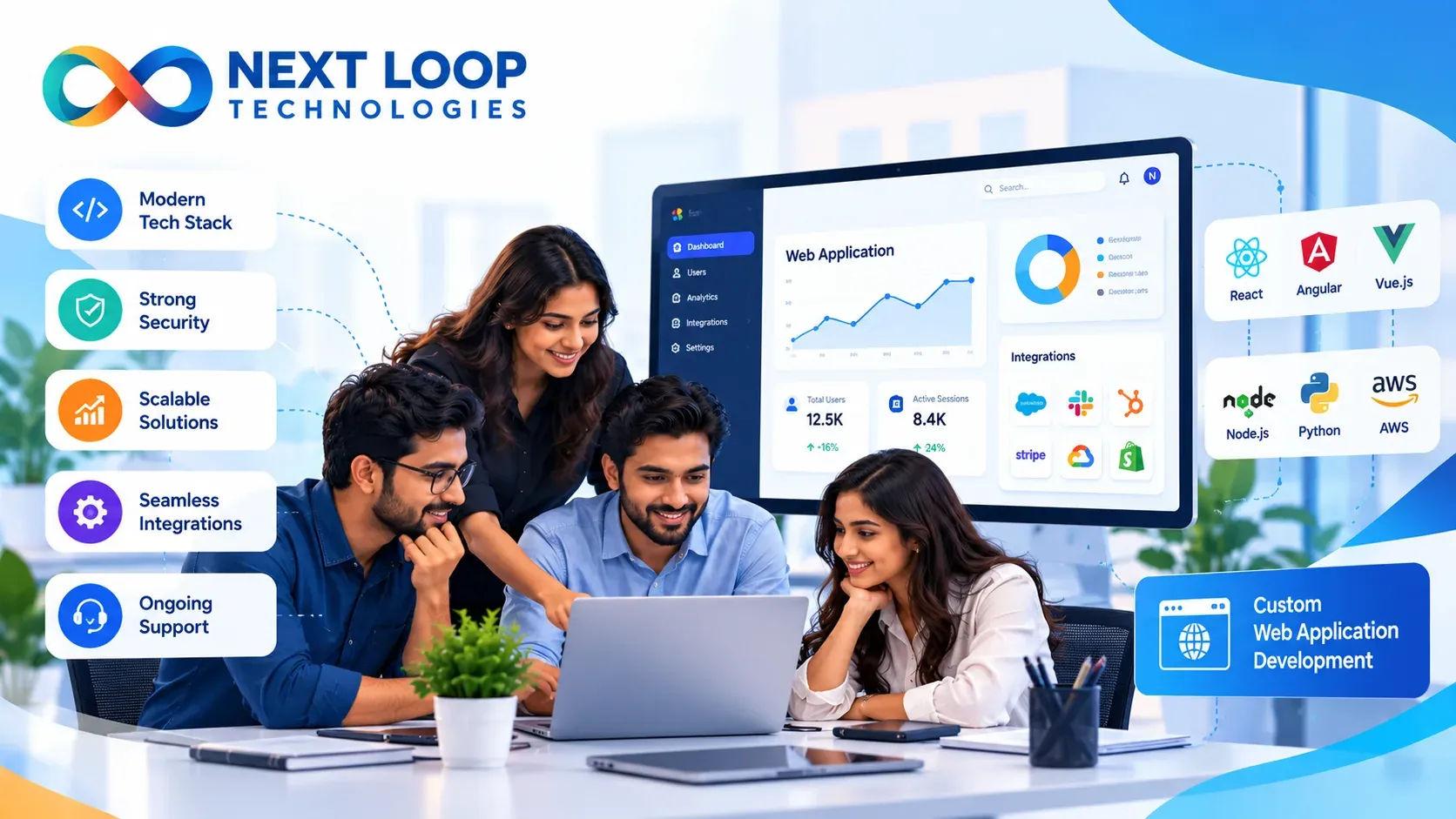
- Which frontend tools do they use, such as React, Angular, or Vue.js?
- Which backend languages and databases do they work with?
- Do they use cloud platforms for hosting and deployment?
- Can they explain why a certain tool is right for your project?
A good partner picks tools based on your needs, not their habits. At Nextloop Technologies, our teams work with modern frameworks like React, Angular, Vue.js, and Svelte. We choose the stack only after we understand your goals.
How Can You Tell If a Company Takes Security Seriously?
Your web app will likely store customer details, logins, or payment data. One breach can break trust that took years to build.
Look for these signs:
- Data encryption for stored and shared information
- Secure logins and user access controls
- Regular security checks and code reviews
- Testing for weak spots before launch
- Knowledge of rules like PCI compliance for payments
This matters even more for large companies. In enterprise web application development, one app may serve thousands of users across many teams, so security must be planned from day one.
Will the App Be Able to Grow With Your Business?
Your app may start with 100 users and reach 100,000 a year later. If it isn't built for growth, it will slow down or crash right when you need it most.
Ask how the team handles scalable web application development. Good answers include cloud hosting, clean code structure, and load testing before launch.
If you want to test an idea first, MVP development services let you launch a simple version, learn from real users, and then grow with less risk.
Sometimes growth means going beyond one web app. A partner that offers custom software development services can also build internal tools, dashboards, or automation as your needs expand.
Can the Web App Connect With Your Existing Tools?
Most businesses already use tools like a CRM, payment gateway, ERP, or email platform. Your new app should work smoothly with all of them.
Ask about:
- Their experience with APIs and third-party integrations
- Past projects that connected similar systems
- How they keep data in sync between tools
A skilled web application development company will map these connections early, during planning. This avoids nasty surprises halfway through the build.
Also think ahead about mobile. If you may need a phone app later, a partner that also works as a mobile app development company can keep your web and mobile products in sync.
What Does a Clear Development Process Look Like?
A clear process keeps your project on time and on budget. You should always know what is being built and what comes next.
At Nextloop, we follow four simple steps:
- Discover: We learn about your business, users, and goals.
- Design: We create wireframes, easy-to-use screens, and the system plan.
- Build: Our engineers work in short agile sprints, so you see progress often.
- Deliver: We test the app fully, launch it, and keep watching its health.
This kind of structure is key in custom web application development, where every feature is made for your exact workflow.
Ask any partner to walk you through their steps. If they can't explain it simply, treat that as a red flag.
Who Will Maintain and Support the App After Launch?
Launch day is not the finish line. Apps need bug fixes, updates, speed checks, and new features over time.
Before you sign, ask:
- Do they offer ongoing maintenance plans?
- How fast do they respond when something breaks?
- Will the team that built the app also support it?
The best web application development services include support after launch, not just the build. This keeps your app safe, fast, and up to date.
How Do You Compare Cost, Team, and Track Record?
Price matters, but the cheapest quote often costs more later. Compare the value, not only the number.
Check:
- Portfolio and case studies in your industry
- Client reviews and ratings
- Team size and skill mix
- Clear pricing and flexible hiring models
Some businesses already have an in-house team but need extra hands. In that case, IT staff augmentation services let you add skilled developers without long hiring cycles.
As a web app development company with 8+ years of experience, 80+ tech professionals, 40+ successful projects, and 98%+ client satisfaction, Nextloop Technologies supports startups, healthcare providers, and global enterprises. We serve fields like fintech, healthcare, oil and gas, and food and beverages.
Start Your Search With a Simple Shortlist
First, write down your must-have features, budget, and timeline. Then shortlist three companies and ask each one about tech, security, growth, integrations, process, and support.
Compare their answers side by side. The right partner will answer clearly, ask smart questions back, and care about your goals.
If you want a partner that checks all these boxes, Nextloop Technologies is ready to help. Talk to our team today and see why businesses trust us as their web application development company.
Key Takeaways:
- Pick a partner whose tech stack fits your goals, not just the latest trend.
- Ask how they secure your data, from encryption to testing.
- Make sure the app is built to handle more users over time.
- Check that they can connect the app with the tools you already use.
- Look for a clear process and real support after launch.
FAQs:
1. How long does it take to build a web app?
A simple web app may take 2 to 4 months. A complex one with many features and integrations can take 6 months or more. Testing and feedback rounds also affect the timeline.
2. How much does it cost to build a web app?
The cost depends on features, design, integrations, and team size. The best way to know is to share your needs and ask for a detailed, itemized quote.
3. What is the difference between a website and a web app?
A website mostly shares information. A web app lets users do things, like log in, book a slot, place an order, or manage data.
4. Should I launch a small version of my app first?
Yes, if your idea is new. Launching a basic version first helps you test demand, collect real feedback, and spend your budget more wisely.
5. Can I add new features after my web app goes live?
Yes. If the app is built with clean code and a flexible structure, your team can add features, improve speed, and update design over time.