
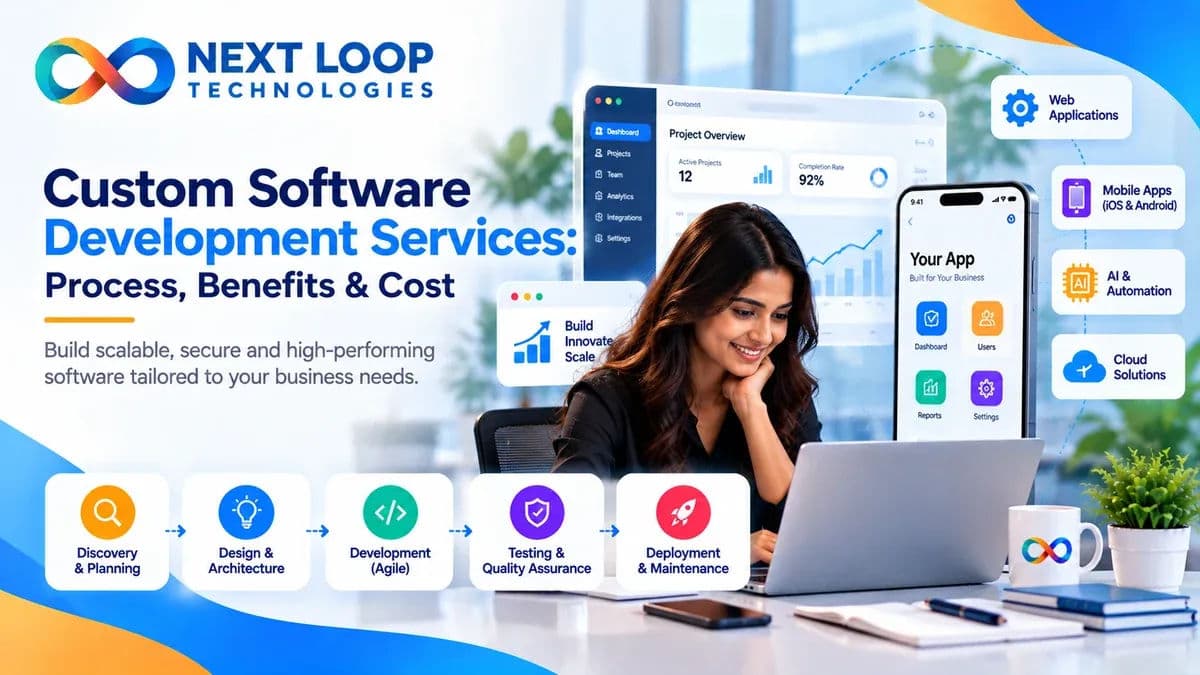
Custom Software Development Services: Process, Benefits & Cost
The Author
Aditi Agrawal is an SEO Executive at Nextloop Technologies who writes about SEO, digital marketing, technology, and emerging trends in the digital landscape. Her work focuses on sharing practical, easy-to-understand insights to help businesses strengthen their online presence and visibility.
Why keep adapting your workflow to software that was never built for your business? Custom software development services help companies create tools around their specific processes, goals, and team needs. Instead of juggling multiple apps or paying for unused features, businesses can build one solution that fits.
In this guide, we’ll explain how custom software differs from ready-made tools, cover the main development stages, explore key benefits, and discuss what affects the overall cost.
What Does Custom Software Actually Mean?
Custom software is built for a specific business and its users. Custom software development services cover planning, building, launching, and maintaining the solution.
It can be a dashboard, customer portal, SaaS product, or automation tool. You decide its features, design, and users.
Many companies also add AI features like chatbots, forecasting, and document processing from the start.
How Is Custom Software Different from Off-the-Shelf Software?
Think of off-the-shelf software like a ready-made suit. It fits most people well enough, but rarely fits anyone perfectly. Custom software is the customized version, cut to your exact size.
Here's a quick comparison:
Off-the-shelf software
- Quick to set up
- Lower upfront cost
- Generic features built for everyone
- Monthly fees that grow with every new user
- Little control over updates or data
Custom software
- Built around your real workflow
- You own the code and the data
- Grows as your business grows
- Connects easily with your existing tools
- Higher upfront cost, but lower long-term cost
Bespoke software development makes the most sense when your process is what sets you apart. If a generic tool would force you to change the very thing that makes you better than competitors, building your own is usually worth it.
On the other hand, if your needs are simple and common, like basic email or payroll, a ready-made tool is often enough.
What Does the Development Process Look Like?
Good software doesn't happen by accident. It follows a clear lifecycle where each stage builds on the one before it. At Nextloop Technologies, we follow five simple stages:
- Discovery and planning: We learn about your goals, users, and problems, then map out requirements before any code is written.
- System architecture and design: Our architects plan the database and server setup, while designers create simple, easy-to-use screens.
- Agile engineering: Our team delivers working features in two-week sprints, so you see progress often.
- Quality assurance and testing: We run automated, load, and security tests to catch problems early.
- Deployment and maintenance: We launch your product, monitor it closely, and keep improving it over time.
This approach reduces surprises by letting you review features regularly and make changes early. MVP development services also help you launch a simple version, collect feedback, and focus on features users need.
What Types of Software Can You Build?
The answer depends on who will use the software and where they'll use it. Most business projects fall into a few common types:
- Enterprise software for complex internal workflows and large amounts of data
- Web platforms and SaaS products that run in any browser
- Mobile apps for iOS and Android users
- AI and automation tools that handle repetitive tasks
- Cloud and DevOps setups that keep everything fast and stable
Browser-based products need fast performance and smooth user experiences across devices. Mobile apps should work naturally on both iOS and Android. Custom tools like admin panels, booking systems, and inventory trackers can also save significant time.
Why Do Businesses Invest in Custom Software?
The biggest benefit is control. Businesses can build software around their workflows, connect existing tools, and avoid unnecessary features. Custom software solutions can also improve scalability, security, and efficiency as the company grows.
By owning the software, businesses have more control over updates and features while avoiding rising per-user costs. AI tools can further automate tasks such as reporting, lead sorting, and customer replies.
How Much Does Custom Software Cost?
There's no single price tag, because every project is different. Here's a rough idea based on common project sizes:
- Simple app or first version: $15,000 – $40,000
- Mid-size web or mobile platform: $40,000 – $100,000
- Complex enterprise system with AI or heavy integrations: $100,000 – $250,000+
Several factors push the price up or down:
- Number and complexity of features
- Number of third-party integrations
- Design detail and custom animations
- Platforms covered (web, iOS, Android)
- Team location and hourly rates
- Ongoing support and maintenance needs
Team location can affect your budget. An experienced offshore team in India can help reduce costs without compromising quality. Fixed pricing suits clear project scopes, while hourly work fits changing requirements. If your team lacks specific skills, you can also bring in experts temporarily when needed.
How Do You Choose the Right Development Partner?
Price matters, but the cheapest quote can cost more through delays and rework. Before signing, check:
- Portfolio and case studies
- Development and testing process
- Communication and progress updates
- Code and IP ownership
- Post-launch support
Choose a team that is transparent about timelines and past work. Custom software is a long-term investment that needs ongoing updates and support.
Start Your Custom Software Project with a Clear Plan
Nextloop Technologies brings years of experience, successful projects, and a skilled tech team to every build. Serving businesses across industries, the company focuses on secure, scalable software solutions.
Start by identifying the task that takes your team the most time. That’s often the best place to begin.
Ready to build a solution? Reach out to Nextloop Technologies and turn that challenge into a practical product.
Key Takeaways:
- Custom software is built around your business, not the other way around.
- Ready-made tools are faster to start, but custom tools win on control, integrations, and long-term value.
- A clear five-stage process keeps your project on time and on budget.
- Cost depends on features, integrations, platforms, and team location.
- Starting small with a lean first version is the smartest way to reduce risk.
- The right partner matters as much as the right technology.
Frequently Asked Questions:
1. How long does it take to build custom software?
A simple first version can take 2 to 4 months. Larger platforms with many integrations often take 6 to 12 months. Agile sprints help you launch core features sooner.
2. Who owns the source code after the project ends?
In most cases, you do. At Nextloop Technologies, your code and intellectual property belong to you, and we follow strict security practices to protect them.
3. Is custom software a good choice for small businesses?
Yes, if your workflow is unique or you're paying for several tools that don't talk to each other. Starting with a lean version keeps costs manageable.
4. Can new software connect with the tools I already use?
Absolutely. Most projects include connections to CRMs, ERPs, payment gateways, and accounting tools, so your data flows in one place.
5. Do you offer support after the software goes live?
Yes. We provide ongoing maintenance, server monitoring, updates, and quick fixes so your software keeps running smoothly long after launch.