

AI Agents: The Future of Automation and Decision-Making
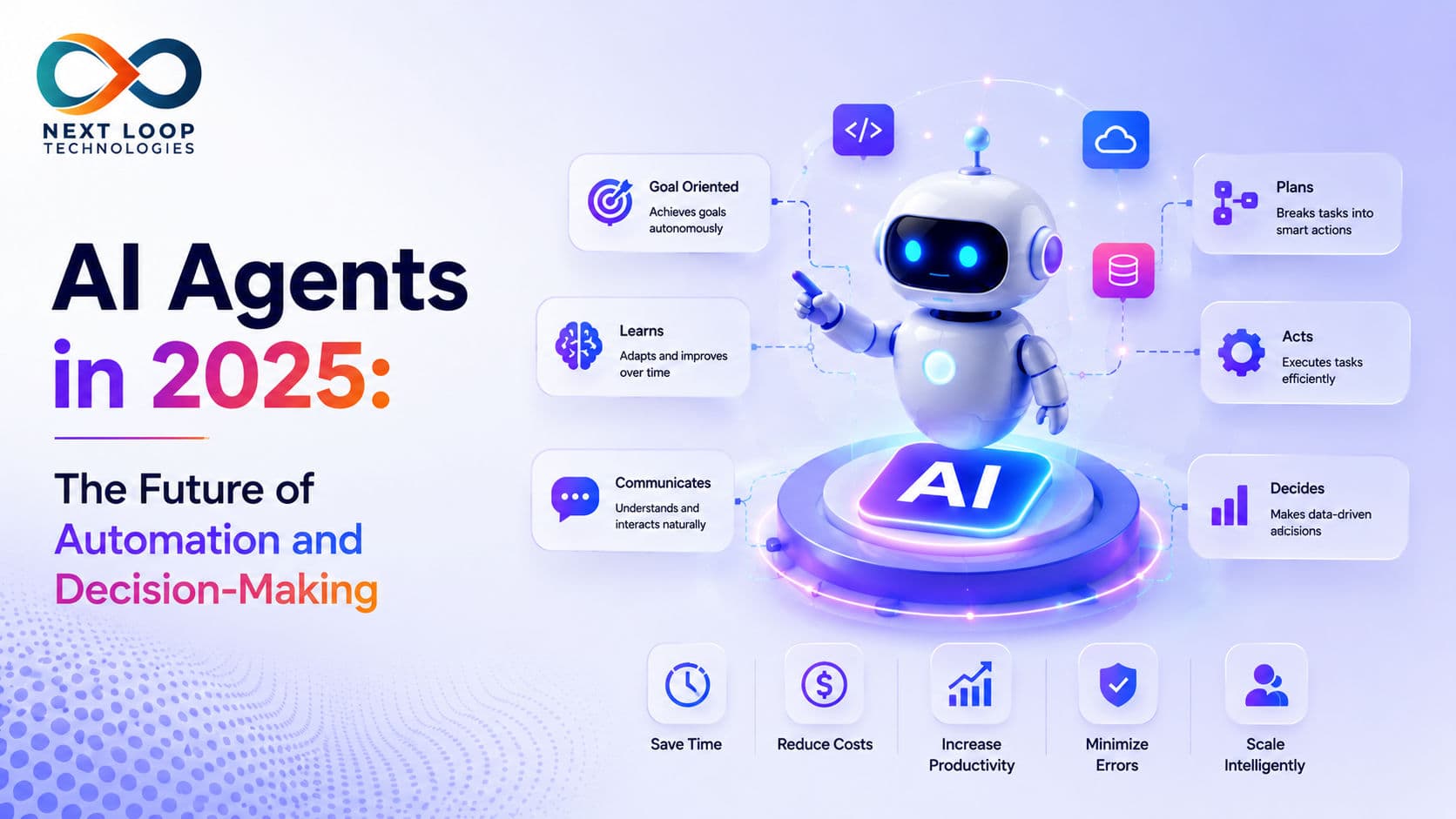
Artificial intelligence is evolving beyond systems that simply respond to prompts. AI agents can pursue defined goals, use tools, process information, and perform multi-step tasks with varying levels of autonomy. These capabilities are creating new opportunities for businesses to automate workflows, improve customer experiences, and support decision-making.
In this guide, we’ll explore what AI agents are, how they work, their benefits, their applications across industries, and the challenges businesses should consider when adopting them.
What Are AI Agents?
AI agents are software systems that perceive information, reason about tasks, and take actions to achieve specific goals. Depending on their design, they can interact with applications, retrieve information, use external tools, and adapt their actions based on feedback.
Unlike conventional automation, which typically follows predefined rules, AI agents can handle some tasks that require contextual understanding and multi-step decision-making. However, their capabilities depend on the underlying models, tools, permissions, and level of human supervision.
How Do AI Agents Work?
AI agents generally follow a cycle of observing, reasoning, acting, and evaluating results.
- Receive an objective: The agent is given a task or goal to accomplish.
- Gather information: It collects relevant data from user inputs, databases, documents, or connected tools.
- Plan the next steps: It determines an appropriate sequence of actions based on the task and available information.
- Execute actions: It uses authorized tools or applications to carry out the planned steps.
- Evaluate the results: It checks the outcome and adjusts its approach when necessary, within its configured limits.
Human approval may still be required for sensitive, high-impact, or irreversible actions.
How AI Agents Are Transforming Key Industries
AI agents have potential applications across industries where information processing, workflow coordination, and decision support are important.
1. Customer Service
AI agents can answer common questions, retrieve relevant information, assist with troubleshooting, and route complex requests to human support teams. With appropriate safeguards, they can help businesses provide more consistent support beyond standard working hours.
2. Healthcare
AI agents can support administrative workflows, organize medical information, and assist healthcare professionals with research and documentation. Clinical decisions must remain subject to appropriate professional oversight, privacy safeguards, and applicable regulations.
3. Finance
Financial institutions can use AI agents to assist with document processing, fraud investigation workflows, transaction monitoring, and financial data analysis. Decisions involving investments, lending, or financial risk require suitable validation and human oversight.
4. Manufacturing
AI agents can help monitor operational data, identify potential production issues, coordinate maintenance workflows, and support inventory planning. Their effectiveness depends on reliable data, system integration, and appropriate controls.
5. Retail and E-commerce
Retailers can use AI agents to assist with product discovery, customer inquiries, inventory analysis, order tracking, and personalized recommendations. Human intervention may be needed when requests involve refunds, disputes, or exceptions to business policies.
What Are the Key Benefits of AI Agents?
When implemented for suitable use cases, AI agents can offer several business benefits.
Improved Operational Efficiency
AI agents can coordinate multi-step workflows and reduce the manual effort required for repetitive information-based tasks.
Better Decision Support
By gathering and analyzing relevant information, AI agents can help employees evaluate options and make more informed decisions. Their outputs should be verified when accuracy is critical.
Personalized Customer Experiences
AI agents can use relevant customer context to provide more tailored responses, recommendations, and assistance, subject to appropriate consent and data protection requirements.
Greater Scalability
Well-designed agent systems can support growing workloads by handling additional tasks, although computational costs, system capacity, and monitoring requirements must be considered.
More Effective Human-AI Collaboration
AI agents can take care of routine work while employees focus on complex problems, relationship-building, strategic planning, and decisions that require human judgment.
What Are the Challenges of Using AI Agents?
Despite their potential, AI agents introduce technical, operational, and ethical challenges that businesses should address before deployment.
Job Displacement and Workforce Changes
Automation may change certain job responsibilities and reduce demand for some repetitive tasks. Businesses can prepare by investing in employee training and identifying opportunities for human-AI collaboration.
Bias and Fairness
AI agents may reproduce biases present in their training data or operating environment. Testing across relevant scenarios and monitoring outcomes can help identify and reduce unfair results.
Data Privacy and Security
Agents that access company systems or customer information require appropriate permissions, secure integrations, and clear data-handling policies. Access should be limited to what each agent needs to perform its assigned tasks.
Accountability and Human Oversight
Organizations need clear ownership of agent actions, defined escalation procedures, and audit logs. Human review is especially important for decisions that affect people's rights, finances, safety, or access to essential services.
Reliability and Unintended Actions
AI agents may misunderstand instructions, produce inaccurate information, or take inappropriate actions. Testing, restricted permissions, spending or action limits, and approval checkpoints can reduce these risks.
How Can Businesses Get Started with AI Agents?
A phased implementation can help organizations assess the value of AI agents while managing risk.
Step 1: Identify a Suitable Use Case
Look for a repetitive or information-intensive workflow with clear objectives, measurable outcomes, and manageable risks.
Step 2: Assess Data and System Readiness
Determine whether the agent will have access to reliable data, compatible applications, and the tools required to complete its tasks.
Step 3: Define Permissions and Guardrails
Establish which actions the agent can perform independently, which require approval, and when it must escalate a task to a human.
Step 4: Test in a Controlled Environment
Evaluate the agent using realistic scenarios, including unexpected inputs and failure cases. Measure accuracy, task completion, processing time, and operating costs.
Step 5: Monitor and Improve
Track performance after deployment, review errors, update workflows, and reassess security and compliance as the system evolves.
How AI and Machine Learning Development Services Help Build AI Agents
Developing useful AI agents requires more than connecting a language model to a workflow. Businesses may need suitable machine learning models, reliable data pipelines, application integrations, secure tool access, and testing processes to ensure that an agent performs its intended tasks effectively.
AI and machine learning development services can help businesses explore intelligent applications, predictive systems, and AI-powered workflows tailored to their operational requirements. The right development approach depends on the business problem, available data, required integrations, and the level of autonomy appropriate for the application.
At Nextloop Technologies, businesses can explore AI and ML development services to learn more about applying artificial intelligence and machine learning to their digital transformation initiatives.
Whether an organization is evaluating intelligent workflow automation, data-driven applications, or customized AI solutions, a structured development process can help align technical capabilities with business objectives. Responsible implementation should also account for privacy, security, reliability, and human oversight.
What Does the Future Hold for AI Agents?
AI agents are likely to become increasingly capable of coordinating tasks across software applications and supporting more complex business workflows. Advances in reasoning, tool use, and system integration may make them useful in a wider range of operational settings.
However, greater autonomy does not automatically guarantee better results. Businesses will need to balance efficiency with reliability, security, transparency, and appropriate human control. Organizations that evaluate AI agents against clear business goals and introduce them gradually will be better positioned to understand their practical value.
Conclusion: Are AI Agents the Future of Business Automation?
AI agents represent an important development in automation and decision support. By combining information processing, tool use, and multi-step task execution, they can help organizations improve workflows, support employees, and deliver more responsive customer experiences.
Successful adoption depends on choosing the right use cases, establishing safeguards, and continuously monitoring performance. With a responsible implementation strategy, businesses can explore how AI agents fit into their broader digital transformation plans.
Want to explore how AI can support your business goals? Connect with Nextloop Technologies to discuss potential opportunities for intelligent automation and AI-driven solutions.